 author
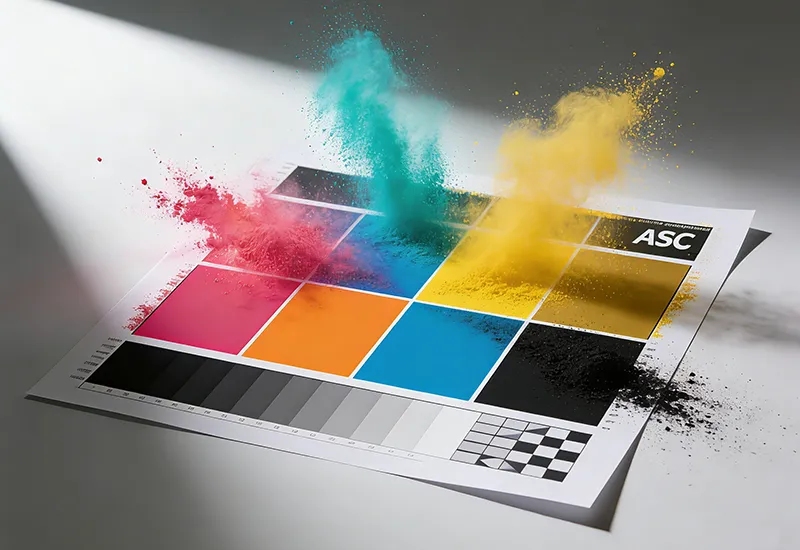
Color printer toner is a carefully engineered mixture of materials that determine how effectively it reproduces images on paper. The primary components include resin, pigments, charge control agents, and additives. Each element contributes to specific performance characteristics—resin acts as the binding matrix that fuses pigment onto paper, pigments provide color and opacity, charge control agents regulate electrostatic behavior, and additives enhance flow and stability.
ASC inherits the German process and management system, adheres to independent research and development and technological innovation, and was one of the first to adopt a fully automatic mixing system, ultrafine grinding and a high-precision air classifier unit to ensure that the carbon powder particle size D50=5–10μm, span<1.3, and particle size distribution: CV<25%. This level of precision ensures that each component interacts optimally during printing.
The balance between these materials determines toner efficiency and stability. If pigment concentration is too high or resin ratios are inconsistent, print quality can degrade due to poor fusion or uneven color distribution. Therefore, modern toner formulations emphasize uniformity in both chemical composition and particle morphology.
While black toner relies primarily on carbon black for pigmentation, color toner—or colored toner—uses multiple pigments such as cyan, magenta, and yellow to reproduce full-color images. Pigment selection directly influences vibrancy and accuracy; organic pigments yield vivid hues while maintaining transparency necessary for color blending.
Mid-to-high-speed copier toner and color copier powder cartridges are its core competitive products. In these products, formulation adjustments ensure consistent fusion across temperature variations so that prints remain sharp even under high-speed conditions.
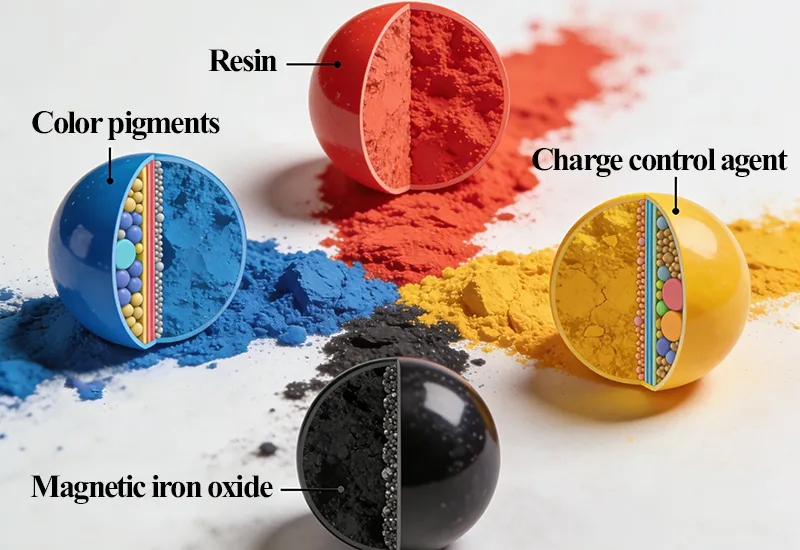
Pigments in color toner are chosen based on their optical properties, durability, and cost-effectiveness. Organic pigments provide bright colors with good light transparency—ideal for layering multiple hues during printing. Inorganic pigments such as oxides or chromates deliver superior heat resistance and chemical stability but may reduce brightness slightly.
In 2009, ASC obtained an invention patent from the State Intellectual Property Office for its “Dry Physical Color Toner and its Preparation Method,” filling a domestic technological gap. This innovation enhanced pigment dispersion efficiency by improving how pigment particles interact with resin matrices.
Particle size plays a critical role in determining image resolution. Smaller particles produce smoother gradients and sharper edges because they melt uniformly during fusing. Even pigment distribution prevents streaking or blotching across printed surfaces. Surface treatment technologies further improve compatibility between pigment particles and polymer resins—ensuring stable charge characteristics throughout the printing cycle.
Uniform dispersion ensures consistent color reproduction across every page printed with color printer toner. Poorly dispersed pigments can clump together, leading to dull tones or uneven coloration. Homogeneity also enhances toner flow through developer units, minimizing clogging or mechanical wear inside printers.
Mechanical milling methods such as jet milling or ball milling are used to refine pigment particle size for optimal mixing with resin binders. Controlled energy input is vital—excessive force can degrade pigment structure or alter hue intensity.
The company has a fully automated R&D production line including particle size analyzers, charge analyzers, and colorimeters. These instruments allow ASC engineers to monitor dispersion quality at every stage of production.
Surfactants or polymeric dispersants stabilize pigment particles within resin matrices by reducing surface tension differences. Additives prevent agglomeration during storage or prolonged use inside printers exposed to varying humidity levels. Such stabilization ensures that colored toner maintains its free-flowing characteristics over time without clumping.
Toner must endure high fuser temperatures without degrading pigment quality or altering hue balance. Heat-resistant resins act as protective shells around pigments to maintain visual integrity under pressure.
In 2025, it solved problems related to fixing and bleaching of Canon color toner and solved the problem of ultra-low temperature fixing of Toshiba color toner. This advancement demonstrates ASC’s ability to maintain thermal stability even at lower energy consumption levels.
Factors like exposure to light, changes in humidity, and ozone can lead to chemical changes in toner. These chemicals can change the chemical nature of toner ingredients due to oxidation and thus cause fading or other changes in the color of the print. To prevent that, stabilizers are included in toners.
Microscopic analysis allows researchers to observe how evenly pigments are distributed within resin structures. Spectrophotometric testing measures consistency between batches by comparing reflectance spectra across multiple samples.
All raw materials undergo full inspection upon arrival at the factory; automatic metering ensures uniformity of additives and precise dosage control; full-item testing of finished products in batches of 500 kg upon entering the warehouse (printed samples, durability tests).
Accelerated aging tests simulate years of environmental exposure within weeks by applying controlled heat, humidity, and light cycles to test samples. Results guide formulation improvements aimed at increasing durability under real-world usage scenarios such as office environments with continuous operation.
Eco-friendly design is key in toner manufacturing today. Resins made out of biological materials lower the environmental footprint and ensure that the level of mechanical properties is the same as in oil-based polymers. Fusing at low temperatures increases the energy efficiency of printers by requiring less heat.
Founded in 2003 as a Sino-German joint venture, ASC has achieved independent R&D and large-scale production of a full range of toners from monochrome to color. This foundation enables ASC to pioneer sustainable solutions within global markets.
Pigments that are nanoparticles give the benefit of improved uniform dispersion in smaller quantities owing to their minute size, normally less than 100 nm, leading to more colorful images through less material consumption. “Smart” additives are one such emerging area where the viscosity or charge density is changed dynamically during processing.
Understanding how each component functions within color printer toner helps explain why brands like ASC achieve superior print consistency across diverse devices from Canon to Toshiba copiers. Their innovations—from patented dry physical colored toner technology to advanced dispersion systems—reflect decades of expertise dedicated to balancing performance with sustainability goals.
For detailed consultation about compatible toners or customized formulations suited for industrial applications, contact us through our official service channels.
A: ASC’s color printer toner benefits from patented dry physical processing technology that enhances pigment dispersion uniformity while maintaining low waste rates across high-speed copiers.
A: Each batch undergoes accelerated aging tests combined with microscopic analysis to verify consistent performance under temperature fluctuations and humidity exposure before shipment.
A: No, bio-based resins used by ASC maintain comparable adhesion strength while reducing environmental footprint thanks to low-temperature fusing compatibility verified through internal testing laboratories.
A: Smaller particles allow even melting during fusing stages which results in smoother gradients; this property is optimized using ultrafine grinding systems integrated into ASC’s automated production lines.
A: Yes, professional engineers offer online diagnostics via WhatsApp or WeChat along with on-site optimization services for clients requiring tailored solutions for specific printer configurations.